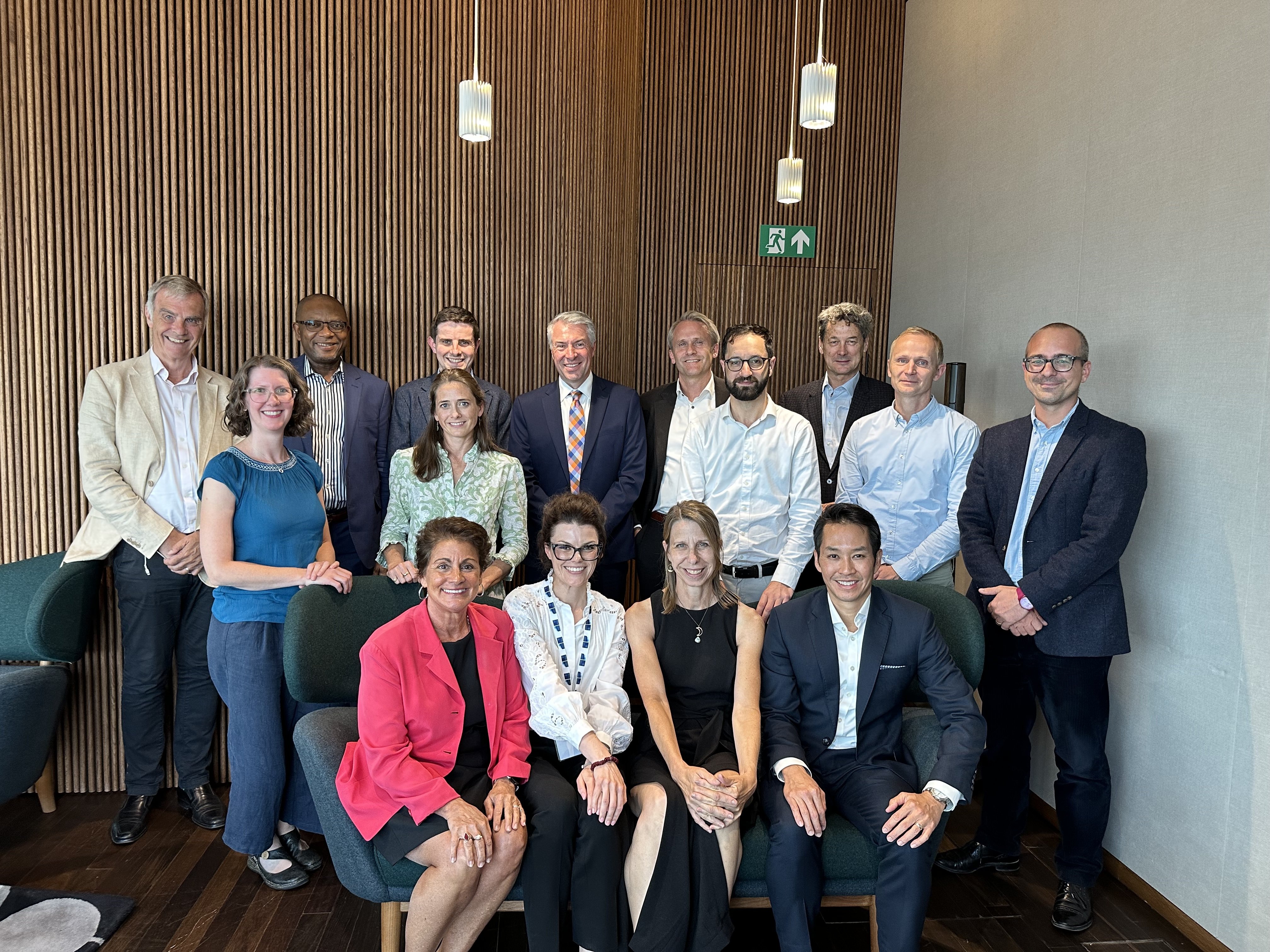
ForeGRound
The Formal-relational Government Contracting Roundtable (ForeGRound) is an international group of academics, policymakers and practitioners interested in understanding the potential and challenges to a formal relational contracting approach in the public sector.
Formal-relational contracting is an emerging approach to governing complex partnerships. It leverages shared goals and principles, alongside governance procedures, to ensure that the formal contract complements the informal relationships between parties, allowing them to work together productively and adapt amidst uncertainty. While it has been pioneered in the private sector, we believe it has the potential to address serious and persistent challenges facing public sector contracting. However, more research is needed to understand whether and where it is effective, and how it can be implemented.
The Government Outcomes Lab acts as the secretariat for ForeGRound. We organised the inaugural session in Oxford in September 2023, and provide ongoing support to communication and future meetings of the group.
If you would like to find out more about the group, including how you can join future sessions, please contact Michael Gibson at michael.gibson@bsg.ox.ac.uk.
Upcoming meetings
More information to follow...
The next roundtable hosted by the ForeGround group is expected to take place in June 2027 at the Public Management Research Conference in Budapest, Hungary.
Past meetings
Roundtable: Developing a research agenda in the space between formal and relational contracting
This session brought together researchers and practitioners to discuss how to develop theoretically informed and empirically testable research agendas in the space between formal and relational contracting in the delivery of public services. The session featured short provocations drawing on different theoretical and empirical perspectives, highlighting emerging evidence, identifying gaps in current knowledge, and reflecting on lessons from applied settings.
The participation and contributions of practitioners was incredibly valuable in considering how we move ideas from “the lab” into real-world settings. The session included a structured discussion where session participants were invited to help shape a focused research agenda by considering which questions are most pressing, what kinds of data and research designs are needed, and how theoretically informed research can be more closely connected to ongoing contracting practices.
The aim was to move towards a clearer and more cumulative research agenda on how formal and relational contracting mechanisms interact, substitute, and complement one another in the delivery of public services. You can read a summary of the discussion in the attached document.
In a special online seminar, we explored the role of Standing Neutrals and the role that they might play in enabling formal-relational contracts in practice. We heard from speakers Kate Vitasek on what a standing neutral is, and the problems it might solve, and David Frydlinger on his experience of serving as a standing neutral in practice across a number of formal-relational contracts.
In 2025, the group reconvened in Oxford for a third annual meeting. This year, we focused in on developing a coordinated research agenda to learn from the pockets of innovative practice growing around the world. Adopting a more workshop-based approach, we explored both the emerging research themes which the field should seek to address, as well as the empirical data – both qualitative and quantitative – which may help to answer those questions.
Following these discussions, we sought to explore opportunities to better coordinate these research activities across the group, including opportunities for collaborative research projects and joint funding.
Formal-relational Contracting Symposium
The second meeting of ForeGRound took place in Roskilde from the 11 to 13 August 2023, hosted by Ole Helby Petersen, Lena Brogaard and their team. We began by rowing and sailing a viking ship up Roskilde Fjord, putting our metaphors about rowing and steering into practice!
This was followed by two days of presentation and discussion. First, we had a research day. Researchers presented a range of papers examining aspects of formal-relational contracting in the public sector, allowing for in-depth exploration of the latest research in the field. We then held a series of roundtable discussions, based on short reflection pieces around emerging topics of interest.
On the next day, we held a research-practice exchange day with Danish public servants who have participated in a research programme to better understand the effects of training public managers in formal-relational contracting practices. Matthew Potoski and David Frydlinger delivered keynote lectures on formal-relational contracting. We then heard from some of the public managers who had undertaken the training, explaining how they were seeking to adopt the approach, as well as some of the challenges and benefits they saw.
Symposium on Formal Relational Contracting in the public sector: a practice frontier and research agenda?
On 13 September 2023, we gathered in Oxford for the inaugural meeting of a group of academics and practitioners interested in exploring the potential for a new approach to public contracting. The state increasingly relies on contracted independent provider organisations to provide a wide range of public goods and services, from stationery and landscaping to aircraft carriers and homelessness reduction programmes. However, often (and particular in the case of more complex contracts), these partnerships between government and private provider organisations fail to deliver public value. Recognising this, we sought to explore how bringing focus to both the formal and relational elements of contracting might help to better serve the public interest. Framing our discussion around i) the contract, ii) negotiations and collaboration, and iii) public law and accountability, we explored several key themes, detailed in the attached summary note. These, we hope, will provide the foundation for an ongoing conversation around how a formal relational approach to public sector contracting might lead to better contractual outcomes.