Orchestrating Education System Change: Insights from the Shikshagraha Movement
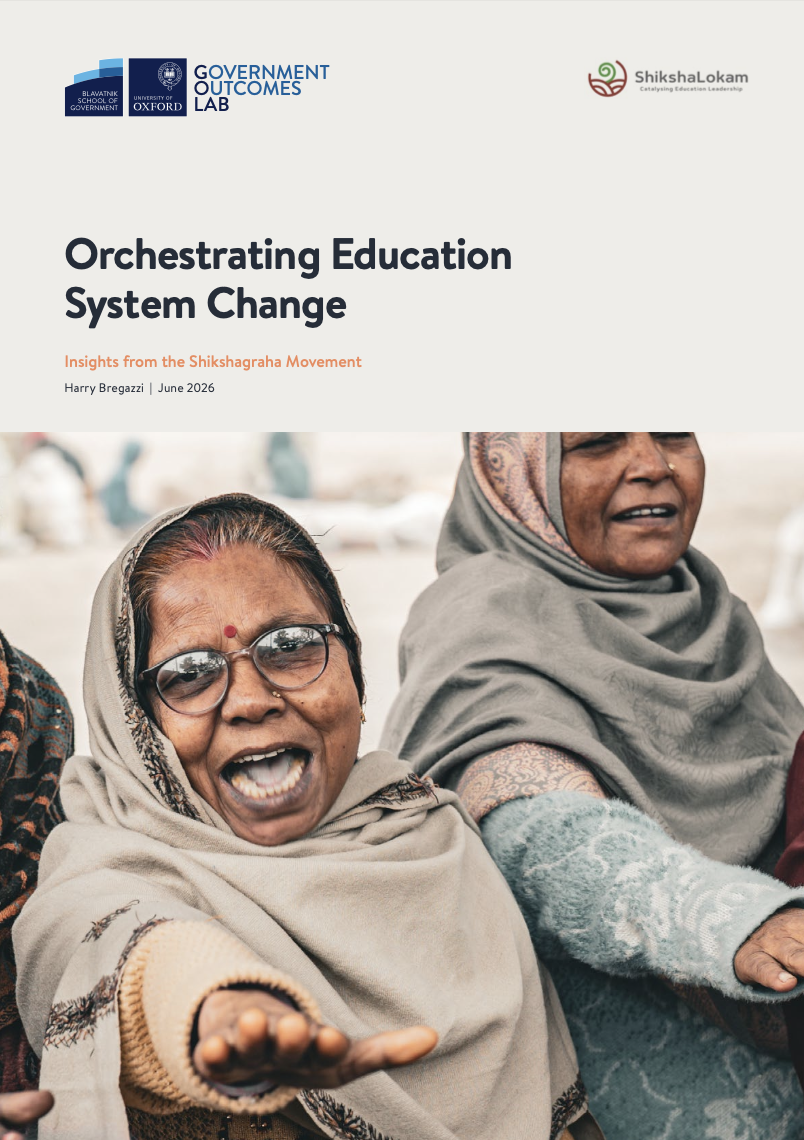
How can governments and civil society work together to support community-led change in India’s education system? This question is the focus of the Government Outcomes Lab’s research partnership with ShikshaLokam. Orchestrating Education System Change marks the culmination of our first year of work together.
How can governments and civil society work together to support community-led change in India’s education system? This question is the focus of the Government Outcomes Lab’s research partnership with ShikshaLokam. Orchestrating Education System Change marks the culmination of our first year of work together.
About the report
For much of the debate around education reform, attention has focused on what governments should do differently. But comparatively less attention has been paid to how change is implemented. Education systems are too complex, contextual and dependent on local knowledge and trust for any one actor to drive lasting change alone. This is the gap that the new playbook seeks to address, offering practical insights into how productive government-civil society partnerships can be built and sustained.
The report distils key lessons from India’s ongoing Shikshagraha movement – a collective initiative for educational reform. Based on the Societal Thinking framework, Shikshagraha coordinates the efforts of government, civil society, communities, teachers, donors, markets, and the media. As such, the movement’s success is dependent on effective relationships between partners.
With Shikshagraha as a case study, the report draws on wider thinking around ecosystem approaches to social change, alongside the lived experiences of those involved in the movement. It covers: (1) the benefits state-society partnership might bring to education reform; (2) the factors that can enable a productive partnership; (3) difficulties that can undermine collaboration for reform; and (4) how such difficulties might be avoided.
The research
The research underlying the report combined interviews and fieldwork. We spoke with 30 stakeholders working within the Shikshagraha movement and the wider Indian education system, including current and former government officials from the central, state, and district levels of administration, alongside staff from a range of education-focused civil society organisations (CSOs).
Some of the CSOs we interviewed are small locally-based organisations, while others operate across multiple Indian states. We also spoke with several philanthropic donors involved in Shikshagraha, who provide funding and strategic support to the reform efforts. Interviewees were selected from five different Indian states: Bihar, Karnataka, Nagaland, Tamil Nadu, and Telangana.
We supplemented interviews with field research in India – in New Delhi, Gaya, Patna,Bengaluru, and Mysuru. This included small focus group discussions with central- and state-level government officials (two central and two state groups), as well as with local CSOs in Gaya and Mysore. These discussions helped augment and refine the report’s findings.
The fieldwork also allowed us to gain greater contextual knowledge of Shikshagraha’s work on the ground. We visited two schools, one preschool, two District Institutes for Education and Training, and two village ‘Shiskha Chaupals’ (community spaces), in which community leaders promote participation in education and address barriers to quality education at the local level.
This work was made possible by the support of Mantra4Change US. We are deeply grateful to the Board. We also extend our sincere thanks to Amee Parikh, Aaradhana Dalmia, Chetan Kapoor, and Janhvi Kanoria for their contributions to the research.