
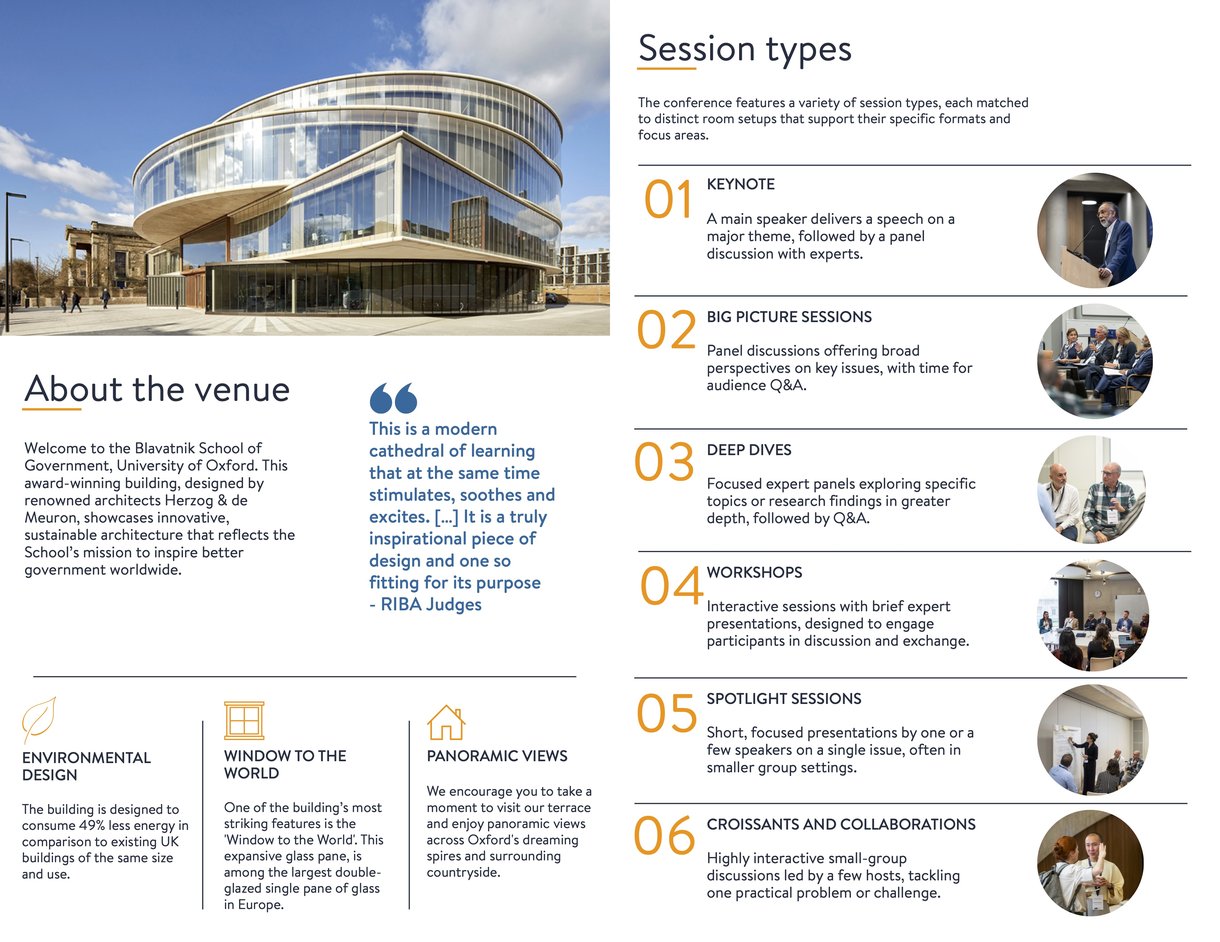
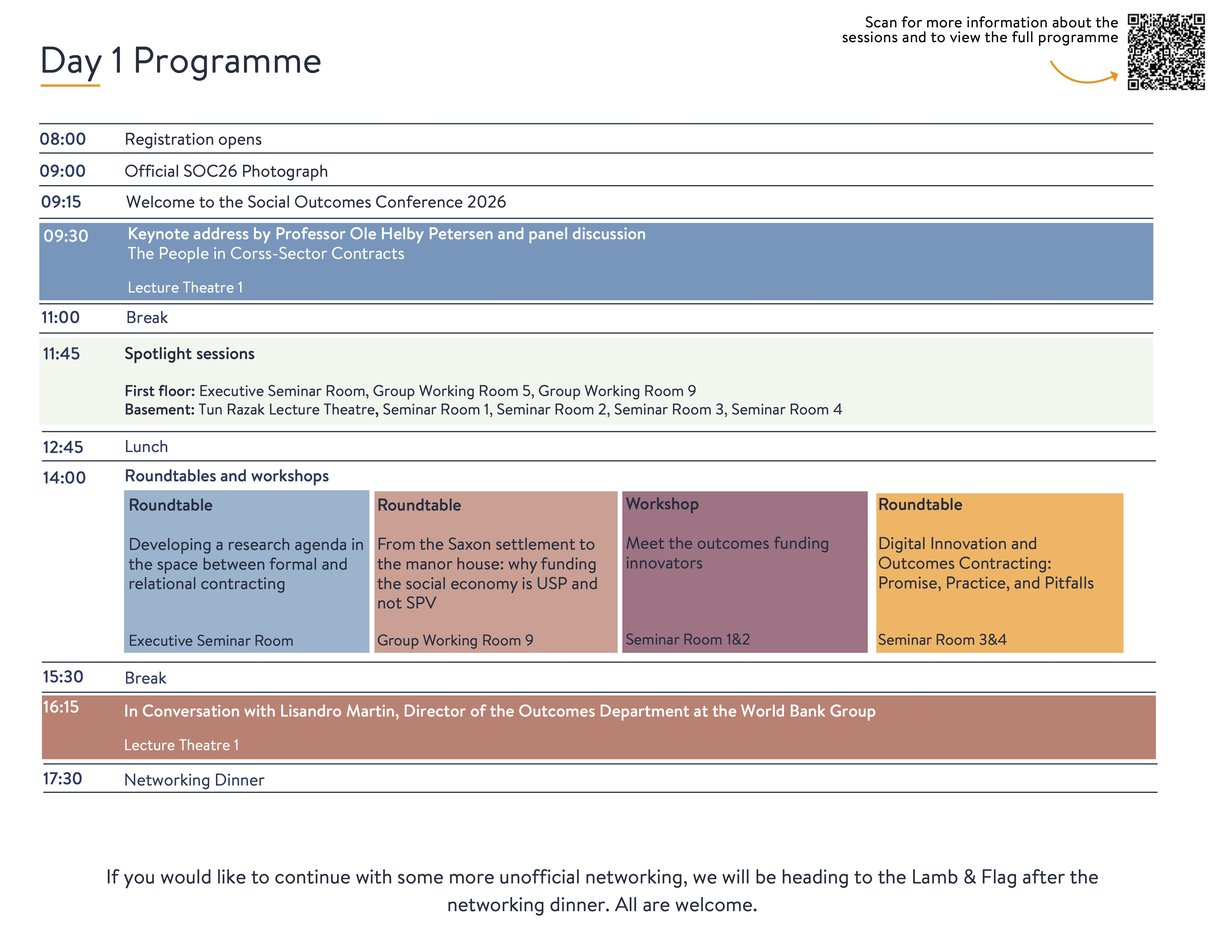
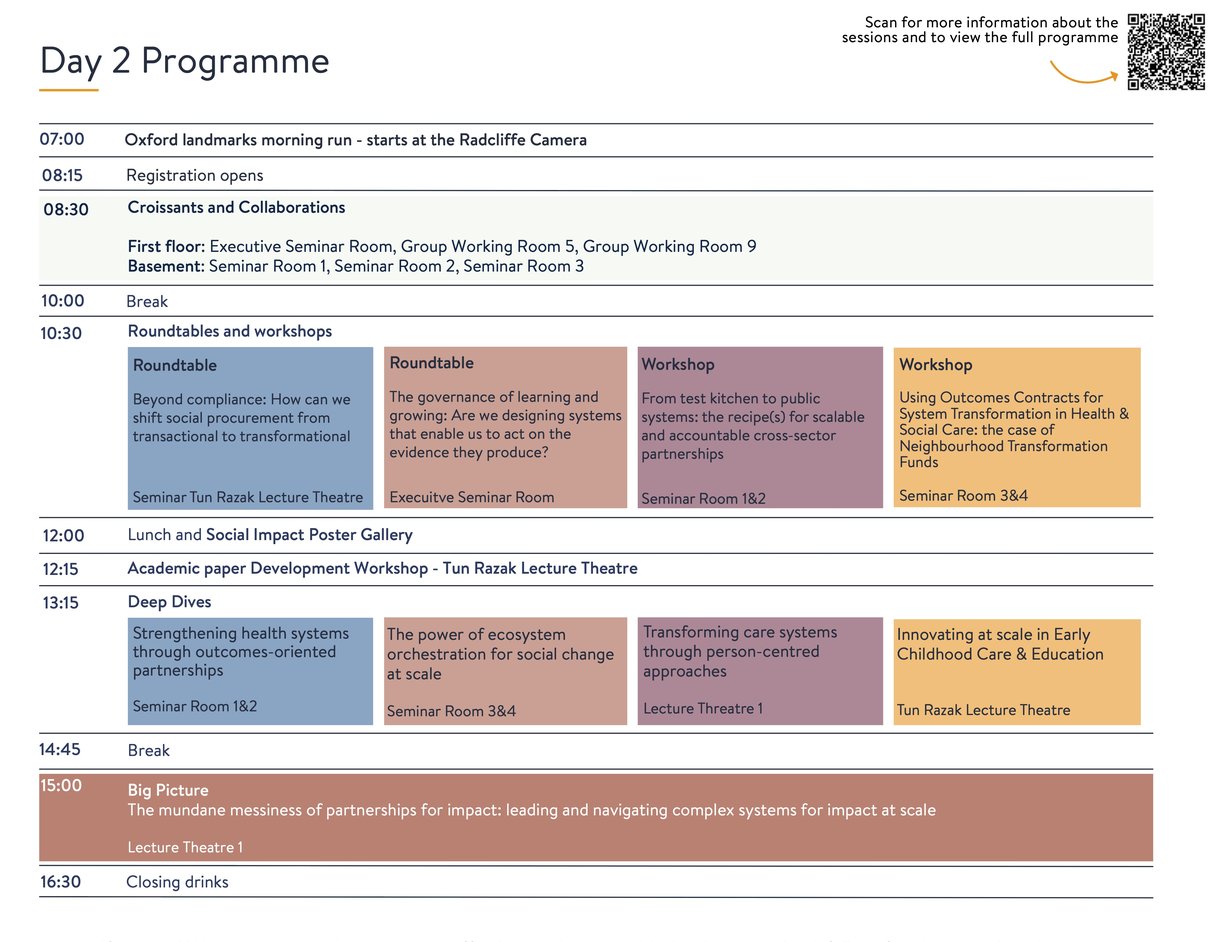
The Social Outcomes Conference 2026 (SOC26) will take place on 3-4 September at the Blavatnik School of Government, Oxford & online.
Delegate Pack




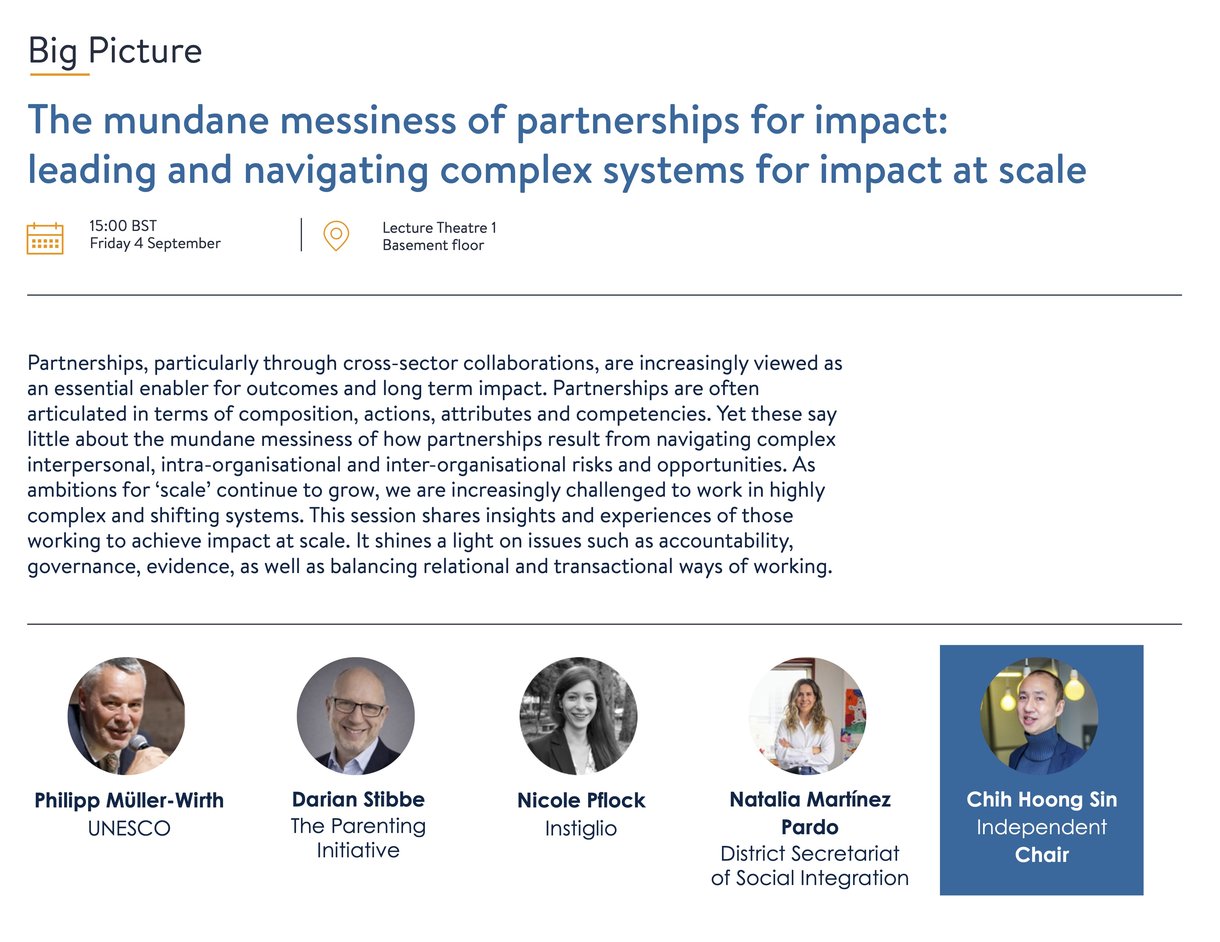

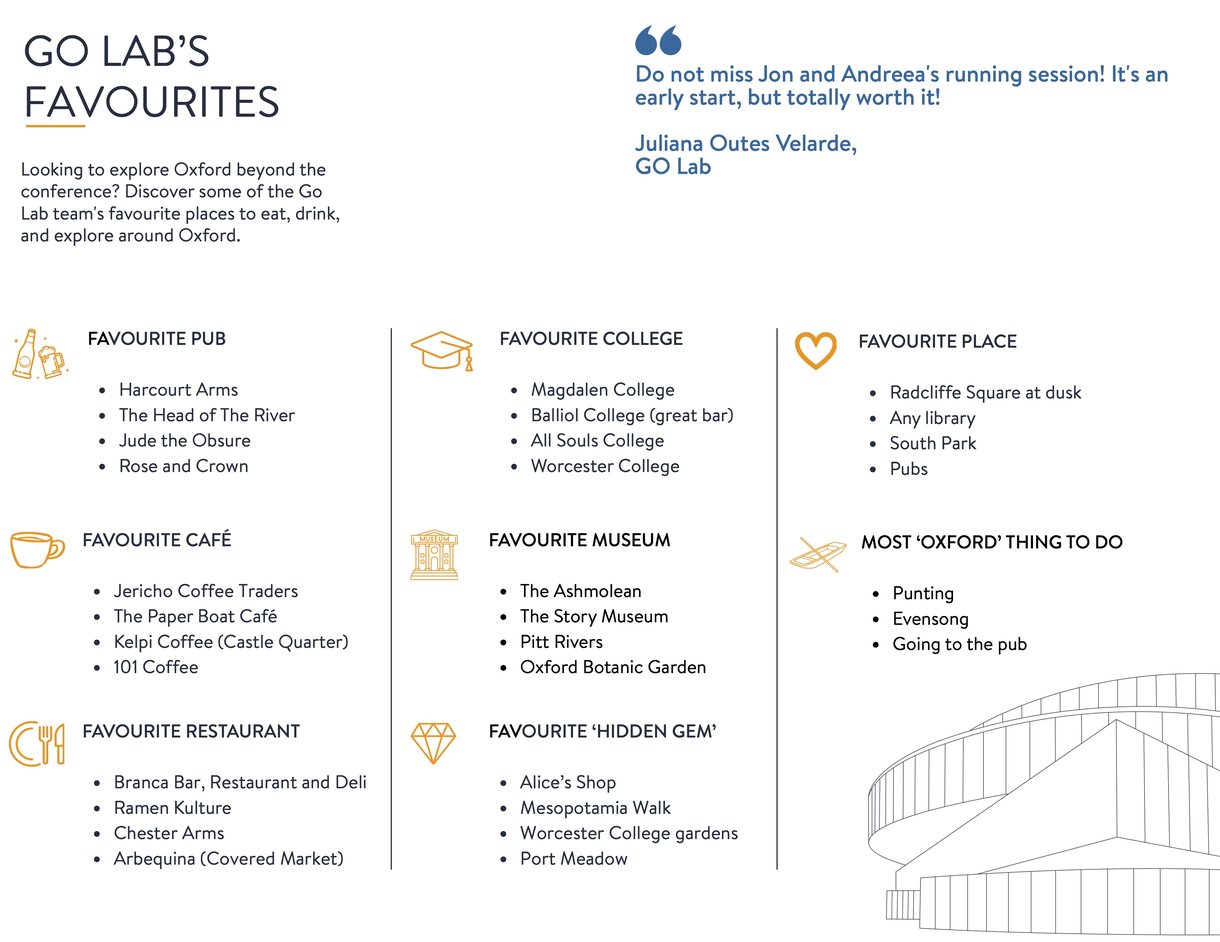
A bridge between scholars and practitioners
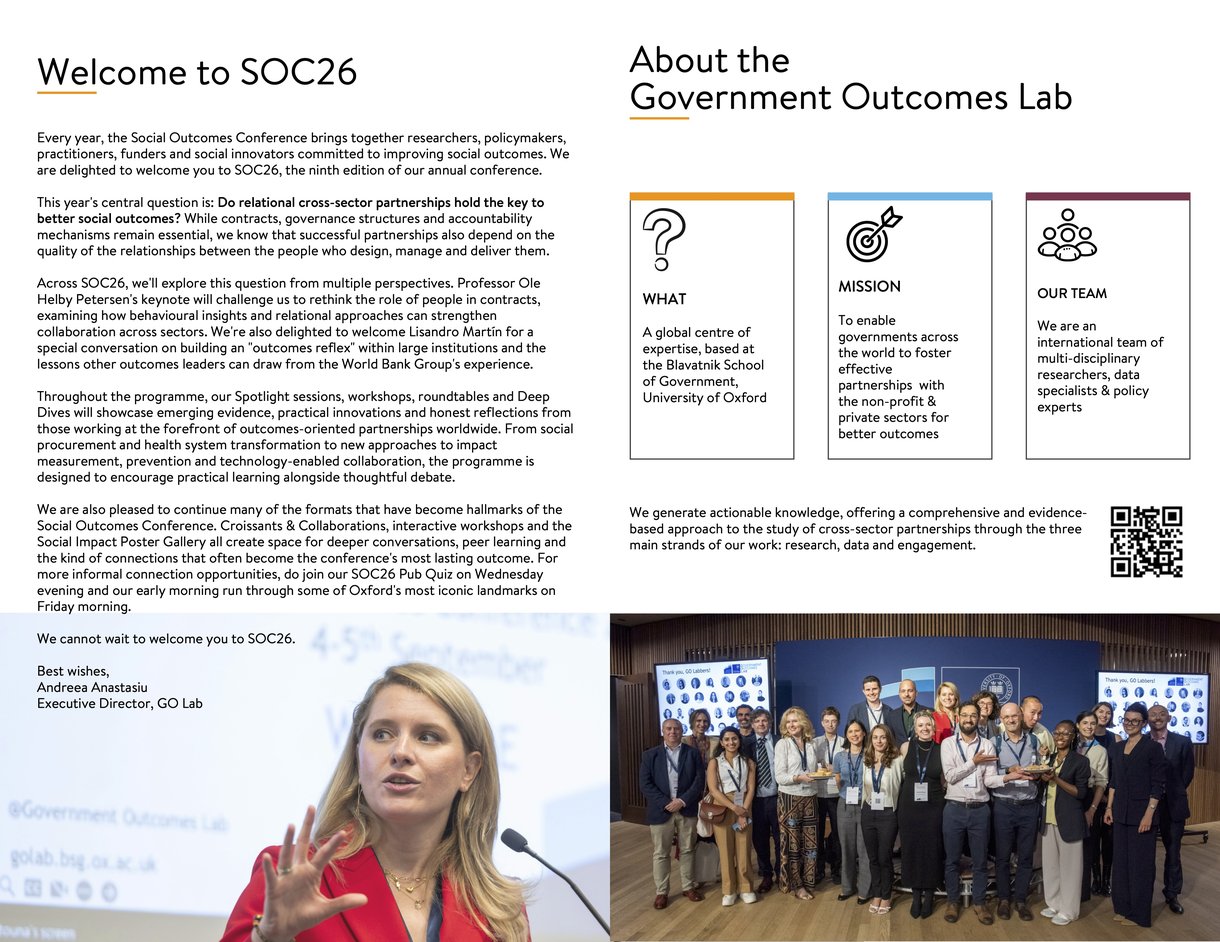
The Social Outcomes Conference is the annual convening of the world's leading researchers, policymakers and practitioners working to improve social outcomes, hosted by the Government Outcomes Lab at the Blavatnik School of Government, University of Oxford.
Since 2018, we have convened a growing global community of policymakers, practitioners and researchers dedicated to improving social outcomes through cross-sector partnerships, offering a space for shared learning and meaningful engagement with the emerging evidence.
The early editions of the conference had a particular emphasis on innovative, outcomes-oriented forms of cross-sector partnerships such as social impact bonds (increasingly referred to as social outcomes partnerships or social outcomes contracts). This has since served as a springboard for exploration of wider questions:
- How can we build effective cross-sector partnerships that drive impact?
- What does it mean to embed meaningful outcomes at the heart of public services?
- How can data and evidence be used to inform smarter, outcomes-focused decision-making?
- What lessons can be applied across sectors to improve policy design and delivery?
- How can government best steward the delivery of social services through an outsourced dynamic?
Though the topics have expanded, the conference remains committed to bridging academia, policy, and practice for better social outcomes, emphasising inclusive evidence-building and open knowledge-sharing. We encourage participants to embrace this interdisciplinary exchange, recognising that learning from those outside one’s immediate field is a valuable opportunity. We are committed to rigorous research and evidence-driven insights, ensuring that academic advancements inform best practices in policy and implementation—and that, in turn, real-world practice shapes the research agenda.
Attendees can expect a dynamic environment that fosters cross-sector dialogue, deepens understanding, and advances the field of outcomes-focused work. As in previous years, the conference will feature discussions on the latest thinking and findings from academic research alongside insights from emerging practice across different geographies, disciplines and policy areas.
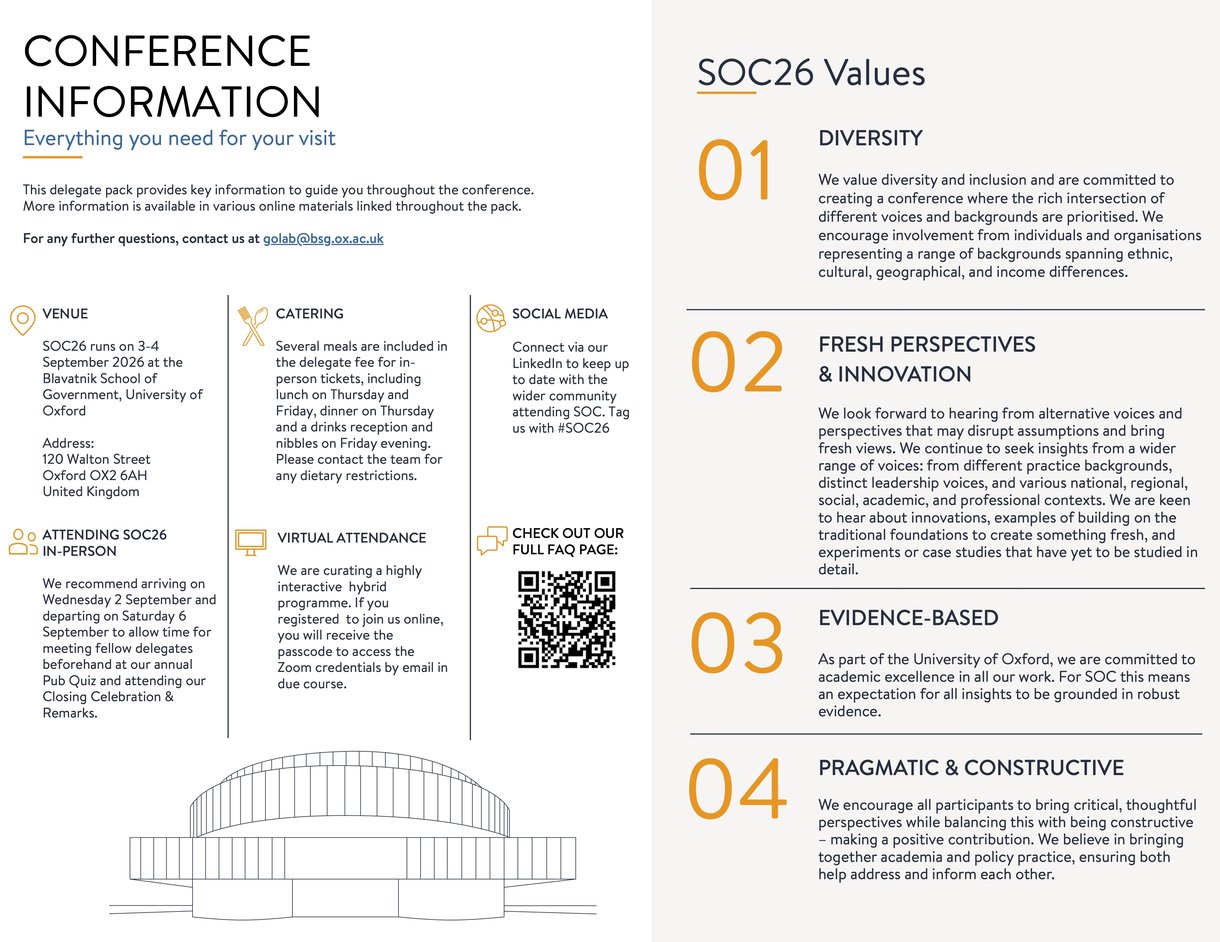
For the Social Outcomes Conference we have four guiding principles which underpins all of our content
- Fresh perspectives & innovation: We are keen to hear about innovations, examples of building on the traditional foundations to create something fresh, and experiments or case studies that have yet to be studied in detail. We wish to hear from alternative voices and perspectives – that may disrupt assumptions and bring fresh views. We continue to seek insights from a wider range of voices: from different practice backgrounds, distinct leadership voices, and different national, regional, social, academic, and professional contexts.
- Evidence-based: We are committed to academic excellence in all our work. For SOC26 this means an expectation for all insights and conference applications to be grounded in robust evidence.
- Diversity: We value diversity and inclusion and are committed to creating a conference where the rich intersection of different voices and backgrounds are prioritised. We encourage applications from individuals and organisations representing a range of backgrounds spanning ethnic, cultural, geographical, and income differences.
- Pragmatic & constructive: We encourage all contributions to bring critical, thoughtful perspectives while balancing this with being constructive – making a positive contribution. We believe in bringing together academia and policy practice – making sure both are helping address and inform the other.
At previous editions of the conference, we heard how new forms of partnerships are needed to enable governments to respond effectively to the increasingly complex and pressing social challenges that citizens across the world face. A growing body of scholarship is pointing to the importance of balancing accountability and flexibility in these partnerships, but practical examples of how to do so successfully remain limited.
For this year’s edition of the Social Outcomes Conference, the central question that we will be exploring is:
Do relational cross-sector partnerships hold the key to better social outcomes?
As more organisations – within and outside government - are becoming more deliberate about weaving both robust accountability mechanisms and flexibility for iteration and data-led adaptation into their partnerships, are there approaches really making a difference? If so, what does it take to develop and nurture successful partnerships that balance formal and relational practices? What does it take to grow this approach? What capacities and skills are needed? What are the limits of this approach? How do we move from the transactional to transformational in purpose-driven partnerships?
This year's keynote speaker
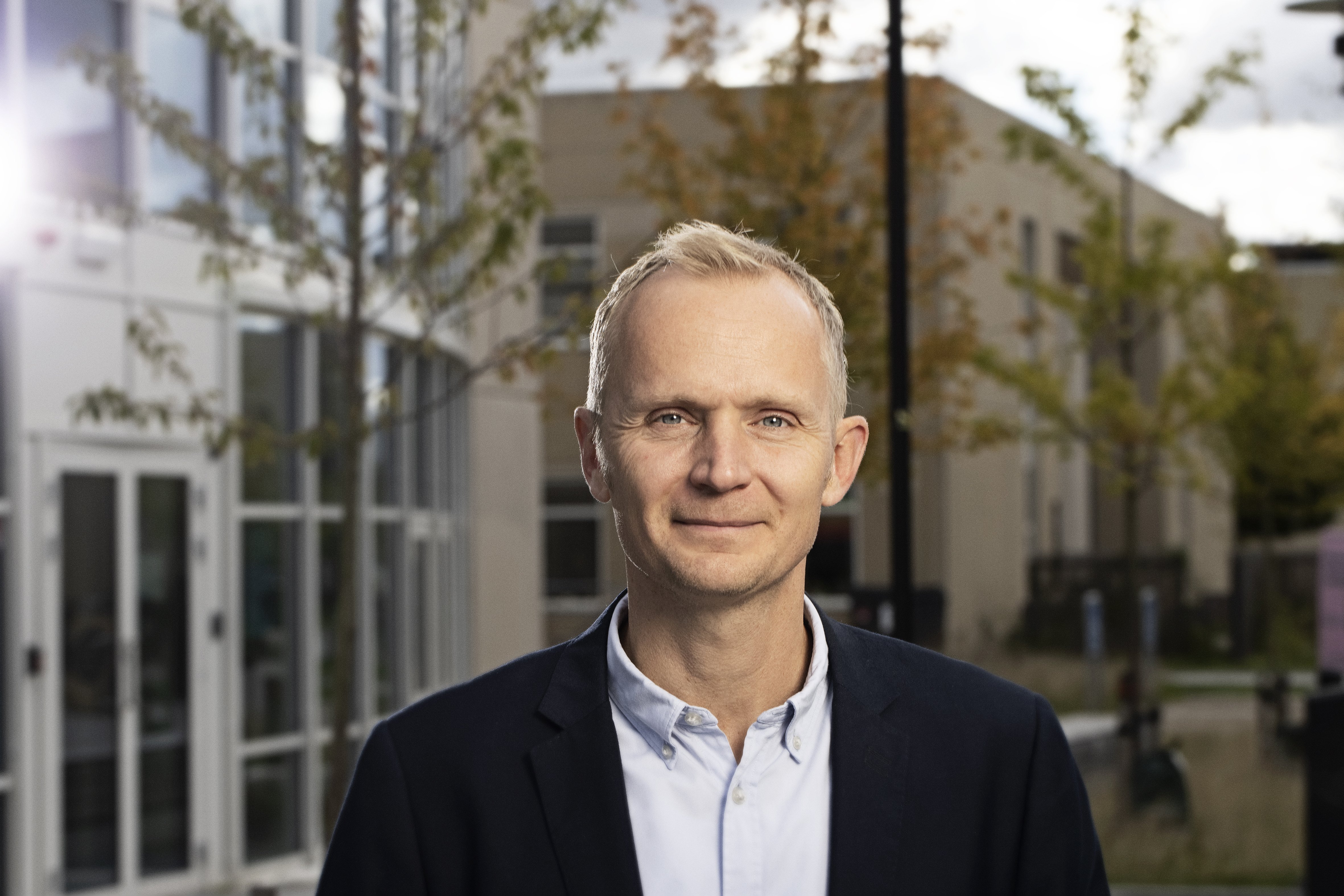
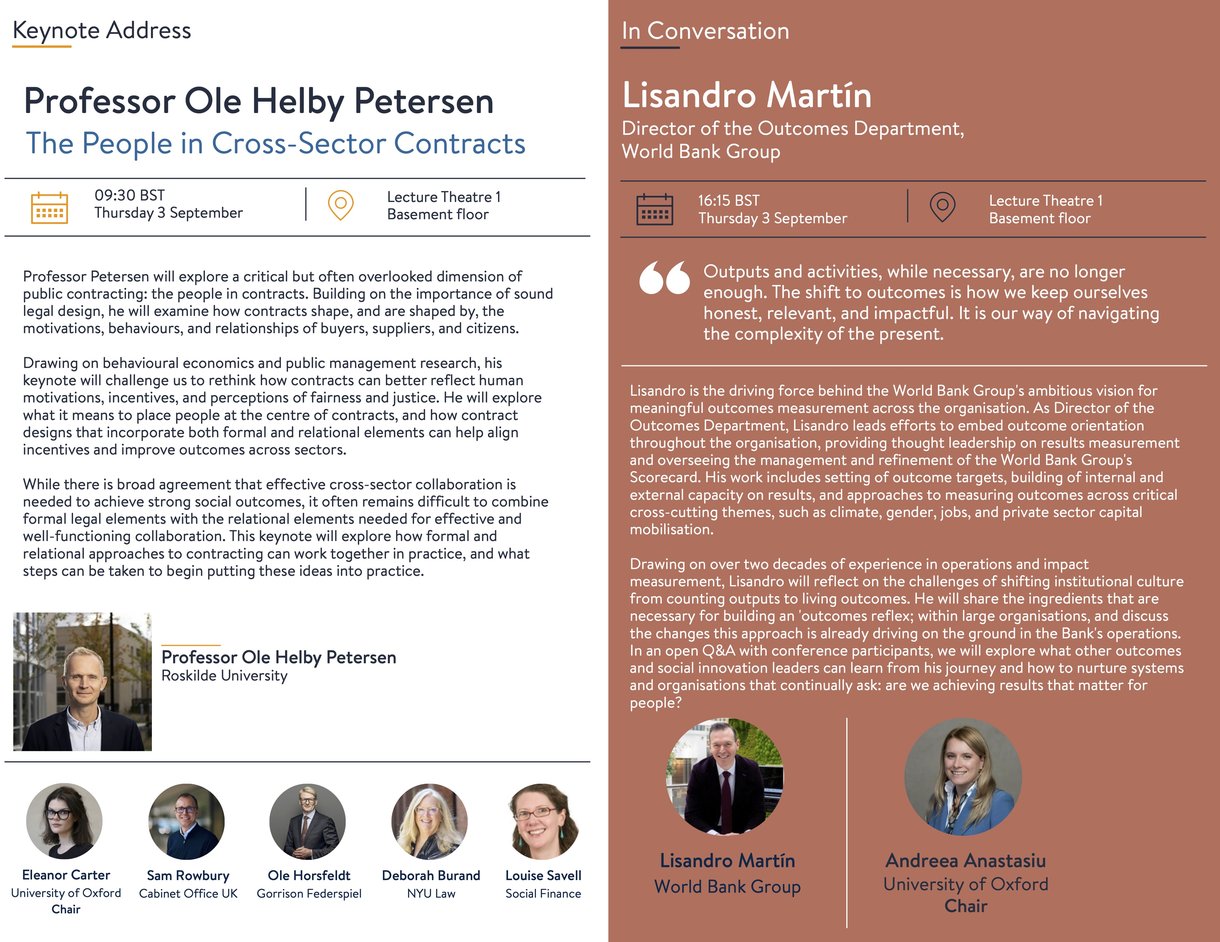
We are delighted to announce that the keynote address at this year’s SOC26 will be delivered by Professor Ole Helby Petersen.
Ole is professor in Public Administration at Roskilde University and Director of the Centre for Research on Public-Private Collaboration. His work focuses on public sector contracting, public procurement, and public-private collaboration. He has published extensively in leading journals and is currently leading innovative research projects applying big data, machine learning, and natural language processing to public procurement and contract governance.
In his keynote, Professor Petersen will explore a critical but often overlooked dimension of public contracting: the people in contracts. Building on the importance of sound legal design, he will examine how contracts shape, and are shaped by, the motivations, behaviours, and relationships of buyers, suppliers, and citizens.
Drawing on behavioural economics and public management research, his keynote will challenge us to rethink how contracts can better reflect human motivations, incentives, and perceptions of fairness and justice. He will explore what it means to place people at the centre of contracts, and how contract designs that incorporate both formal and relational elements can help align incentives and improve outcomes across sectors.